Showing posts with label Art. Show all posts

Tuesday, February 17, 2015

FotoFilmic'15 - Shortlist #01 Announced


The first Short List Call of the FotoFilmic’15 International Juried Film Photography Competition recently ended and FotoFilmic has just announced the names of the first 30 Short Listed photographers.


Submissions are being accepted for Short List #02. Submit your film based photography work here to be considered to be among the next 30 selected artists.

Saturday, October 11, 2014

Video Interview with dnj artist: Alain Laboile


LensCulture has recently featured a video interview with dnj Gallery artist Alain Laboile. In this video, Laboile discusses his photographic style and techniques, and shares some advice for photographers.


To see Alain Laboile's interview, please click here.


Alain Laboile, Reservoir Chickens, 
Digital pigment print 
16" x 20" or 30" x 40"


Alain Laboile, Lili, 
Digital pigment print 
16" x 20" or 30" x 40"


Alain Laboile, Supernova, 
Digital pigment print 
16" x 20" or 30" x 40"


For interests in purchasing a photograph by Alain Laboile, please contact us.

Saturday, September 20, 2014

Pro Photo Daily: Unlocking the Secrets of the Creative Process


An article posted through AI - AP shares insight into the creative process. 
For advice on how to unlock your inner artist, please read their article reposted below:


American Photography's 

Pro Photo Daily:


Unlocking the Secrets of the

Creative Process


by Eric Meola

Reposted from American Illustration and American Photography.
The original article can be seen here.

At a recent workshop in Maine, the noted National Geographic photographer Sam Abell asked his students to photograph a poem—to illustrate the words with images. Abell wanted the students to think about the relationship between two methods of describing imagery, and the challenges posed by interpreting words and images in our minds through photography. The dichotomy between words and images has haunted me throughout my career, and then a few months ago, a nearly 200-page PDF attachment of an e-book called Process arrived in my email as a gift from photographer-lecturer-educator John Paul Caponigro—or JP, as his friends call him. I glanced at a few pages, then put it aside on my computer’s desktop to look at later. I had met JP on several occasions—first in California before we were both scheduled to do lectures, and then again in Iceland, Antarctica and the Atacama desert while participating in Digital Photo Destinations workshops. I had only a few sketchy things to go on—that JP had graduated from Yale, that his father was the photographer Paul Caponigro, that he had grown up in New Mexico, and that he took a few weeks off to go to Italy every year.
So one day, when I got a call from my somewhat inebriated photographer-friend Arthur Meyerson and an equally inebriated JP as they joyfully celebrated the close of a Maine Photo Workshop, I told JP that I had not only readProcess but that I wanted to interview him about it. I had a lot of questions: How was his famous father? Did his mother really design Ernst Haas’s book The Creation? And most importantly, what the hell was Process really about? After all, we live in the age of iPhone photography, when nearly 300 million photographs are uploaded to Facebook every 24 hours. 

In the book Invisible Republic: Bob Dylan's Basement Tapes, critic Greil Marcus describes the process that led to Dylan’s collection of more than 100 mostly unreleased songs; the music evolved from—in Marcus’s words—“a laboratory where, for a few months, certain bedrock strains of American cultural language were retrieved and reinvented.” Few photography workshops explore the creative aspects of photography as a constantly evolving set of inputs—reading, writing, sketching—that manifest themselves in the way we make images. I recognized that many of my inputs had much in common with what JP was discussing, but I wanted to know more about him and why he always seemed to be “looking away” from the image in front of us. Or was he?
Our conversation, which begins below, took place over an extended period via email, while JP was with his family in Italy.

EM: I’m fascinated by your approach to seeing, to “living” photography, which you refer to as “process.”  
JP: Art arises out of a life lived—it’s an extension of ourselves, our creative process grows and changes as we do. Art is not something separate from life. Art intensifies life.  Some cultures don’t have a word for art, considering the items/events produced that we might call art to be an overflowing of life. Seen from that perspective, everyone is an artist. So the follow-up questions would be: What kind of artist and how well do they do it?
EM: Your father is Paul Caponigro, a master landscape and still-life photographer. He once said, “It's one thing to make a picture of what a person looks like, it's another thing to make a portrait of who they are.” That applies to all photography, doesn’t it—from landscapes to journalistic images to portraits?
JP: Exactly. Representation is not reproduction. We make portraits of people by recording light reflecting on their bodies—often only a portion of their bodies, usually from one angle and at one moment in time. Does such an image record their changing state through time, their history, their web of relationships, their ideas, their feelings, etc? It’s important to recognize the limited nature of our creations. In representation. it’s important to recognize the gap between what we create and what’s referenced. This doesn’t make these types of images less valuable; for many people they’re the most valuable. Perhaps those limitations can be used for effect?
I spoke about this when talking about a book that is very influential to me—Jamake Highwater’s The Primal Mind. Listen to it here (under “Voice”).
EM: You recently did a print “pair” with your dad, who lives with you. His image "Galaxy Apple" is one of my favorites. How is he, and how much did he influence your own way of thinking about images?
JP: Dad’s “Galaxy Apple” is one of my favorite photographs, too. Its ability to speak both literally and metaphorically at the same time is one of the possibilities photography presents that fascinates me most, and it influenced my decision to become involved in the medium.
Dad’s influence on me as a person and an artist has been tremendous. How could it not be? He’s my father! In addition to influencing the course of my early life, presenting many interesting experiences, and influencing my world-view, he’s always been available personally, generous with his knowledge, and supportive of me as an artist. He’s an exceptionally sensitive human being. Among many other things, I appreciate his independent spirit, his unconventional thinking, and how willing he is to chart his own course. Without the influence of both of my parents I doubt I’d be as interested in spirituality, comparative mythology, relationships between man and nature, and music.
At 82 dad’s sharp and active. And yes, he’s still working—we’re going to do another print pair together soon.
EM: Your mother, Eleanor, was also an influence, I presume—after all, she designed the most influential book of photography ever—Ernst Haas’s The Creation. You must have been four or five years old at the time … did you meet Haas at that early age? What was it like to grow up in a world of art?
JP: Most people don’t know how big an influence my mother has been to me. She’s been as strong an influence on me—both as a person and as an artist—as my father. She was the painter in the family and started me drawing. She kindled my interest in “sacred” geometry and numerology. She taught me most of what I know about offset reproduction, which helped me tremendously in making the transition to digital printing and in consulting for corporations producing printers. She laid the foundations of my understanding for graphic design. She showed me the power of editing and sequencing images, by helping many artists select, sequence, reproduce and present their images. She showed me the contributions a second pair of eyes can make to artistic growth. Shall I continue?

"Constellation VI," by John Paul Caponigro

My parents’ very different interests in and uses of language sparked an interest in verbal communication and writing. Their very different sensibilities for music displayed personal voice. I experienced both of these on an almost daily basis.
As I’m writing this, a pattern in our family of artists has become clearer to me! All of us didn’t pursue careers in other arts, despite a lot of dedication to them. Mom didn’t pursue a career in painting; she became a graphic designer. My father didn’t pursue a career in music; he became a photographer. I didn’t pursue sequential art—filmmaking and graphic novels. Or did I in an entirely different way than I was thinking? 
There are so many benefits to making the visual verbal. I wrote about that in this blog post: "Making the Visual Verbal"
EM: You grew up in New Mexico, among other places, and as a child you met Brett and Cole Weston, Ansel Adams and Georgia O’Keeffe. Can you tell us a little about that? Did you have any sense of who they were?
JP: I was born in Boston, and my family moved to Ireland for a year when I was two.  Some of my earliest memories are when dad began to photograph megalithic monuments there. Then, after five years in the Connecticut woods, we moved to the high deserts of New Mexico—first to Pojaque (I went from a school where there were two African-American kids to one where there were two Caucasian kids…the rest were Hispanic and Native-American) and then to Tesuque, near Santa Fe.
Santa Fe was the kind of place where you’d walk into a restaurant and see a Navajo medicine man sitting with a Spanish rancher, an Impressionist painter, and a nuclear physicist—today you have to add a Tibetan monk into the mix. After a great private high school, Santa Fe Preparatory School, I attended Yale University and later the University of California at Santa Cruz; in addition to a great education, I got a great education in education. After college I moved near the Maine Photographic Workshops, not realizing that Kodak would soon set up The Center For Creative Imaging nearby and that as an artist in residence I would experience a dream come true—Photoshop. Many years earlier, while my mother was overseeing the production of Eliot Porter’s Intimate Landscapes book, I was shown a Scitex machine, which my mother called “a million-dollar coloring book.” I whispered under my breath, “What if an artist got hold of one of these? I wish I had one!” That wish came true. We traveled a lot and I met a lot of interesting people—that was as much a part of my education as my formal education.
As the son of two parents involved in different but related aspects of the art world, I’ve had meetings with many remarkable men and women. I met all of the people you mentioned and many more. Not all of them were famous. Many people wouldn’t recognize the names of people I met who were very influential to the photography community. Our family of artists would visit artists, curators, dealers, and publishers—or they’d visit us.
When I was very young, I had no idea how other people regarded these people. When I was a kid accompanying my father when he taught in Yosemite, I knew Ansel Adams made beautiful photographs and played the piano beautifully, but to me Ansel Adams was really cool because he had a three-legged dog named “Tripod,” even cooler because he had a tiny adorable wife who often seemed like a fairy-tale character, cooler still because he had his own gallery and workshop program in Yosemite National Park, and the coolest guy on the planet because they told me he had a stick he used for controlling the clouds—that is until I couldn’t find a cloud stick in his camera bag like they said. My appreciation for him deepened when I was older and began to understand how much he did to help other artists and the environment.
As I grew older, I began to realize other people looked at and treated these people differently. Often they treated my father differently; sometimes acted differently. I’ve witnessed a lot of inflated behavior. It’s rarely pretty.
For the most part, my parents didn’t change the way they related to people of notoriety—and neither did I. As a result, I’ve got a somewhat different relationship to celebrity. While I’m interested in what fame does to people’s behavior, fame doesn’t change the way I think and feel about them.
I’ve seen people change their behavior because they became famous. I sympathize, but I don’t respect it. I do respect people who attain fame and don’t let it go to their head. Fame can take a terrible toll on people and the people around them, especially their families. It even takes its toll on people who react to fame in inflated ways. To some, it can be a sign of respect and a relief to stop the nonsense and just be real. While I wish success for everyone, I wouldn’t wish celebrity on anyone. Or rather, I wish our culture’s reactions to fame would mature. I celebrate examples of people using their notoriety conscientiously.
To me, while she’s one of my favorite painters, Georgia O’Keeffe was a grouchy old bat who told me her dogs liked only her (after I’d been licked for hours waiting for my mom to finish working with her). But, aside from being very talented, she was also very intelligent, and I gave her lots of brownie points for recognizing, respecting, and valuing my mother’s talents and contributions when they worked together on projects.
I was deeply impressed by Eliot Porter, who worked with my mother on many projects. He was a Harvard-trained microbiologist who was influenced by Thoreau and who devoted his life to the visual arts. He could speak well about almost any subject (science, politics, business) but not art. That an important elderly person would go out of his way to affectionately challenge a teenager like me, sometimes taking a devil’s advocate position to do it, and expect me to support my ideas well, showing me that we didn’t have to agree to respect one another, was just one of many life-lessons I learned from him.
EM: Why do you think Porter couldn’t speak well about art, of all subjects? Was he uncomfortable discussing art, or photography in particular?  Or was it a subject that transcended discussion in some way?
JP: I found Eliot’s limited ability to discuss art mysterious. (Add to this mystery, his wife was a painter, and two of his three sons became artists—one a sculptor and one a painter.) He was so articulate! He would talk about technique, but not about aesthetics. If I had to guess, I would say he was comfortable discussing anything that related to his substantial scientific training while he was largely self-taught in the arts and so reticent to go further there, but then he wasn’t trained in political science and he was eager to discuss politics. Perhaps, he felt the subject of art was too subjective to make rigorously supported arguments? I’m theorizing here. Related to this mystery was watching him work with my mother to select and sequence his images. He could make photographs (boy could he!). I think he made images intuitively. But he had a hard time evaluating them after they were made. I think developing a stronger capacity to make verbal statements about art would have helped him in those areas.

"Incubation II," by John Paul Caponigro

One of the most important things I learned from all these meetings with remarkable men and women was that that all had their own sensibilities. Some of these people used the same tools but they made very different things with them. That’s inspiring! This is particularly true with photography, which whether chemical or digital is so technological. My father and I would photograph the same things side-by-side using the same tools and make different images. That’s one of my other essential fascinations with photography. How does that happen? It’s a profound mystery. And it’s wonderful!
EM: There is a part of me that rejects “process,” that wants to embrace Weegee’s quote about “f/8 and be there.”  Yet I realize Weegee had his own process, whether it was simply his approach, his philosophy, his own notebooks, sketches, thoughts, or ideas. I think many photographers just pick up a camera and start shooting. The writer Barry Lopez once tried to be a photographer and gave up. In an essay in his book About This Life: Journeys on the Threshold of Memory,he examines the dichotomy between words and images. My favorite part of your book Process is the chapter titled “Write,” in which you discuss titles, poetry, associations and quotes. Why are words so important to photography and to our visual language? 
JP: Isn’t it interesting that this question even needs to be asked? What aspects of photographers want to be non-verbal? When is being non-verbal productive and when is it counterproductive? Other members or our photography community are highly verbal—editors, publishers, dealers, curators, and critics. The fact that the producers in the photographic community are the ones who are the least well equipped to use language productively has consequences.
Words can be powerful tools. Think of all the things you can do with words. Generate ideas. Clarify a response. Determine a goal. Frame a question. Evaluate strengths and weaknesses. Make comparisons and contrasts. Identify an influence. Select an approach. Test a theory. Explore alternatives. Identify what’s missing. Solve a problem. Advocate. Motivate. Evaluate. Find a new direction.
No matter what discipline you’re in, why wouldn’t you use these powerful tools we call words? Try not using them! Can you? So why not use them well and unlock as much of their power as you can?
Many linguists have explored how language influences thought, going almost as far as saying language is thought. Benjamin Whorf said, “Language is not simply a reporting device for experience but a framework for it.” If a culture has a lot of words for something, it indicates those people have a highly developed relationship with it. If a culture doesn’t have a word for something, it indicates either a very different relationship to a subject or a blind spot. Certain tribes in the Amazon jungle have many words for green, but none for blue. The Inuit have dozens of words for snow. We currently have too few words for photography. (At best, we amend the word photography with other words—photojournalism and photo illustration.) Look at all the words we have for various kinds of writing: fiction, non-fiction, poetry, prose, journalism, journaling, interview, biography, autobiography, screenplay, short story, novel, trilogy, epic, lyric, etc, etc, etc. The photographic community and culture at large would do well to repurpose many words drawn from our literary traditions and use them in our visual traditions.
The question is not, “Should I manipulate a photograph?” Since the invention of photography, all kinds of things have been done to photographs. The question is, “What happens when I do or don’t manipulate a photograph?”
Limited language wastes time and results in less productive debates and diverts attention away from more productive discussions. One of the fundamental things I’m trying to address through my work is complicated by limited language. Our culture often talks about people versus nature; we use words like “us” and “it.” We draw lines and take sides. Our current use of language psychologically distances us. This makes it harder to describe people as parts of nature. If we enter that mindset, we think about ourselves and act in our world differently.

_______________________________________________________________________
The exhibition “Paul Caponigro and John Paul Caponigro: Generations” will be on view at the Taubman Museum in Roanoke, Virginia from September 27 through March 28, 2015.
Photographer Eric Meola is a recipient of the 2014 George Eastman “Power of the Image Award.” His latest book is “India: In Word and Image” (Revised and Updated, 2013).

Friday, September 19, 2014

Larson finalist for Photographer's Forum 2014 Best of Contest


dnj Gallery artist R. Dean Larson has been selected as a finalist for Photographer's Forum 2014 Best of Photography contest. As a finalist, Larson's image will be included in their hardcover book, Best of Photography 2014.


Photographer Forum's book, Best of Photography 2014, is scheduled to be published in December of this year and can be pre-ordered here. 

For information regarding purchasing a print by R. Dean Larson, please contact us. 

Saturday, September 13, 2014

Upcoming Exhibition: Suda House

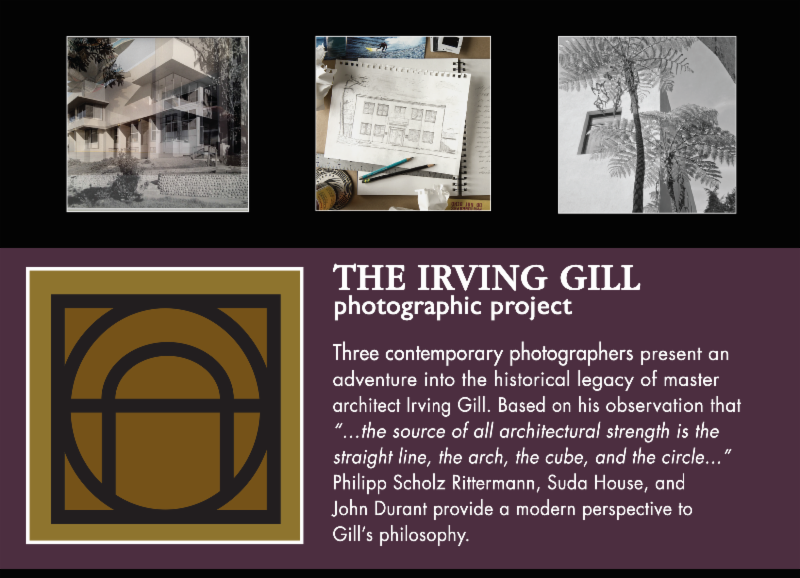
dnj Gallery artist Suda House will be featured in an upcoming exhibition inspired by the design aesthetic and creative philosophy of architect Irving Gill.

Opening Reception


Friday, September 26
5:00pm - 7:00pm
at Wisteria Cottage
La Jolla Historical Society
  
The exhibition will be open Thursday - Sunday, 12:00pm - 4:00pm
September 27, 2014 - January 25, 2015  


"Master Architect Irving Gill (1870-1936) is considered a pioneer of the early modern movement in architecture, and there are numerous examples of his work still remaining in San Diego.  A number of these important buildings are in La Jolla, including the La Jolla Woman’s Club, La Jolla Recreation Center, and at The Bishop’s School and Scripps Institution of Oceanography.  The photographers for this project, Philipp Scholz Rittermann, Suda House, and John Durant, were commissioned by the Society to take Gill’s philosophical idea and produce a body of new works each of which includes all or part of a Gill building.  They were asked to be creative in their interpretation, to diverge from standard building portraits, and to translate a historical idea into a modern perspective.  The resulting exhibition presents an adventure into the legacy of Gill and this unique aspect of his philosophy, and the three artist’s present interpretations that are uniquely suited to the media of contemporary photography."

For more information about the exhibition, 
please click HERE.

Thursday, September 11, 2014

Current Exhibition: Hung Liu

Hung Liu is featured in a current exhibition, Tilling The Soil, now on through October 25, 2014. This exhibition is held at Sherry Leedy Contemporary Art, located in Kansas City, Missouri.


""Tilling the Soil," a selection of paintings from Hung Liu's personal collection, dating from 1993 to the present, is intended both as a parallel exhibition to "Summoning Ghosts: The Art of Hung Liu" at the Kemper Museum of Contemporary Art and - very importantly - as an    homage to the late Byron Cohen, whose enthusiasm for Liu's work over the years has done much to establish her reputation in Kansas City. The fact that the Kemper holds the largest collection of Liu's dramatic and historic art is due in large part to Byron's upbeat faith in her work. 

"Showing at the Sherry Leedy Gallery, the paintings in "Tilling the Soil" depict subjects that have spanned Liu's career, including young Chinese prostitutes from the early 20th century, modern young women from the 1920s, peasants working in the countryside, prisoners, adults longing for the past and day-dreaming children. Together, these paintings - along with new mixed-media works from Trillium Graphics - capture the courageous, historical, and often melancholic gaze toward the homeland that characterizes Liu's sensibility as an artist.  

Hung Liu, Synthesis I, 2014, Oil on Canvas, 60" x 78"

"Born in 1948 and sent to the countryside for four years during the Cultural Revolution, Liu, who emigrated to the United States in 1984, came of age in China before there was a Chinese avant-garde. Older than all but a few of the first generation of contemporary artists there, she represents a perspective based in personal and family experience that takes in the whole of post-revolutionary Chinese history (that is, since the invention of photography). 

"Mostly known for paintings based on historical photographs of nineteenth-century and pre-revolutionary China, including images of prostitutes, refugees, street performers, soldiers, and so forth, Liu also washes (and sometimes washes away) her subjects with veils of linseed oil that, as she once remarked, "both preserve and destroy the image." Preferring to work from black-and-white photographs that are grainy and difficult to see, Liu liberates her subjects from the gray tones of the past by bringing them vividly to life as painted images. In the process of turning old photographs into new paintings, she often inserts traditional motifs from Chinese "bird and flower" painting, Buddhist iconography, or calligraphy, as if to comfort the cataclysms of 20th century China with the wisdom of its own ancient past. 

"With "Tilling the Soil," Liu returns to works that have nurtured her over the years - 
including three brand-new paintings - offering them now in memory of her long-time art dealer, Byron Cohen, one of Kansas City's true enthusiasts for art, for artists, and for the 
community he helped cultivate."

- Jeff Kelley


Thursday, August 21, 2014

El Hurgador Blog features Judy Dater and her portraits of photographers

Javier Fuentes, "The Spanish Art Blogger," recently dedicated a post to Judy Dater and her various portraits of notable photographers taken during the 1970's. Fuentes's bilingual Spanish and English blog, El Hurgador [Arte en la Red], is dedicated to sharing information about art, artists, art events, and anything related to the art world.


Javier Fuentes's full post on Dater's portraits can be seen here.


Judy Dater
Autorretrato / Self Portrait, "La Maga / The Magician", 1981 © Judy Dater

In June this year I published a post dedicated to the remarkable American photographer Judy Dater. While I was selecting pictures, I noticed that during the decade of 1970, Judy portrayed a number of notable photographers. All her photographs are really good. I'll dedicate two posts to this collection of portraits, which will serve me well to provide some information and present some of their works.


André Kertész, 1979 © Judy Dater


Brett Weston, 1978 © Judy Dater

Brassaï, 1973 © Judy Dater

Wednesday, July 23, 2014

Art From Science - Upcoming Exhibition

Las Cruces Museum of Art will be showcasing the works of photographers Leigh Anne Langwell and Patrick Nagatani in the exhibition Art From Science

August 1 - October 11, 2014
Opening Reception will take place Friday, August 1, 5-7pm
Artists’ Talk on Saturday, August 2, 1pm

Hours: Tuesday - Saturday 9am - 4:30pm, closed Sunday & Monday
Group tours are available by appointment. The Museum of Art is free,
open to the public, and accessible.


Wednesday, July 16, 2014

dnj Gallery's Current Exhibition: The Faces of America

dnj Gallery presents

The Faces of America

June 28 - August 30, 2014


dnj Gallery's current exhibition, “The Faces of America” is a photography exhibition which features artwork by dnj Gallery’s artists. These artists explore various themes including self-identity, culture, and environment, while using an array of traditional and experimental photographic processes.

Robert von Sternberg, Oahu (Kodak Hula Show),
1971, carbon ink print, 12 x 8 inches


Allan Gill, Calla Lillies,
2008, archival inkjet print, 16 x 20 inches


2525 michigan avenue, suite J1
santa monica, california 90404
310.315.3551

For directions to our gallery, please click here.
dnj Gallery is now on Artnet, so be sure to check us out!
dnj Gallery is also on Facebook and Twitter.

Tuesday, June 17, 2014

Save Bergamot Station Arts Center from Overdevelopment

Save Bergamot

The Bergamot Station Gallery Cultural Association (BSGCA) is reaching out to the arts community and the public to inform you of the imminent destruction of Bergamot Station Arts Center, should the City of Santa Monica proceed with its current development plans. Dozens of business owners, hundreds of employees, and an endless number of artists and their families as well as the Santa Monica arts community at large, are in serious jeopardy.

We need your support in an effort to save Bergamot Station from overdevelopment. We do not want another Grove or Shopping Mall to replace this unique and historic complex, which has thrived against all odds for over 20 years as well as providing exceptional arts programming and community service. All three development teams under consideration for the contract with the City of Santa Monica propose a massive overhaul to the property which will result in the disruption and closure of many of our businesses. Current development proposals threaten to:

-DECREASE THE NUMBER OF ART GALLERIES
-ADD RETAIL SPACE
-ADD CREATIVE OFFICES
-ADD A HOTEL
-ADD BARS AND RESTAURANTS
-ADD UNDERGROUND PARKING, WHICH WILL DESTROY BUSINESSES ONSITE AND WILL NOT ACCOMMODATE THE NUMBER OF TENANTS WHO WILL BE ADDED TO THE SITE

We, as over 40 art galleries and cultural businesses, respectfully cannot support the City’s plan to turn Bergamot Station into one of these three concepts:


Save Bergamot-3 designs


We have been asking our patrons, associates, friends, artists, and supporters to help us preserve our businesses and our beloved community of galleries and arts related businesses by signing a petition to request that the City of Santa Monica Officials cease plans for redevelopment until the survival of the core tenants of Bergamot Station is ensured.

Thus far, thanks to the overwhelming support in our efforts to help preserve the integrity of Bergamot Station Arts Center, we have gathered over 8,000 signatures on our online petition and have received thousands of powerful statements about the necessity of keeping the heart and soul, THE GALLERIES, of Bergamot Station alive.

We deeply appreciate the community's response to our call to action and have been encouraged by the latest news that the Santa Monica City Council has postponed the vote to select a development team. We now have more time to gather endorsements and to reinforce our core mission - to retain all of the galleries, non-profits, and arts-related businesses that are such a vital resource for the City of Santa Monica and beyond.


Save Bergamot pic


- If you haven't already, please sign our PETITION.
- Share the petition with friends through e-mail or on Facebook and help get the word out.
- "Like" Bergamot Station Arts Center on Facebook and stay tuned for updates on our campaign.
- Send a message to Santa Monica City Council members and tell them why you support the preservation of Bergamot Station and the survival of its tenants.

With your help we will remain a vital part of L.A.'s thriving art scene for another 50 years and more.

Thank You,

Bergamot Station Gallery Cultural Association

Thursday, May 22, 2014

Upcoming Exhibition Harvard-Westlake School "What Remains"


Harvard-Westlake Students


June 7 - June 21, 2014

Opening Reception: June 7, 6 - 8 pm

MACKENZIE-Abandonings-1

Veronica Crow, Haley, 2014,
Selective developing, scanned and digitally manipulated, 16" x 20"

"What Remains"

dnj Gallery is pleased to announce its next upcoming exhibition with Harvard-Westlake photography students. They present a show entitled “What Remains” which will run from June 7 through June 21, 2014.  The students explore a multitude of directions in their digital, as well as analogue images.

Please contact us for more information.

2525 michigan avenue, suite J1
santa monica, california 90404
310.315.3551

For directions to our gallery, please click here
dnj Gallery is now on Artnet, so be sure to check us out!
dnj Gallery is also on Facebook and Twitter.

Friday, April 25, 2014

Why Museums are Focusing on Photography


An article in The Art Newspaper assesses the recent increase in attendance of photography exhibitions in galleries around the country.  

"Last week, the San Francisco Museum of Modern Art announced that it will launch the largest space for photography of any museum in the country in 2016 as part of a major expansion. The John and Lisa Pritzker Center for Photography will have more than 15,500 sq. ft of exhibition space dedicated to the medium. But will the crowds turn out to fill the galleries? If exhibitions at other museums are any sign, the answer is most likely yes."

The article also looks to social media and recent technological advancements as a cause for the increased interest in the medium.

"Social media, and the popularity of photo-sharing networks such as Instagram means that more people are tapping into the medium. 'Everyone can easily make photographs now with their smartphones; it is all about the image,' says Judith Keller, the senior curator of photographs at the Los Angeles-based Getty Museum. This interest may account for the recent rise in attendance figures. 'Photography is perhaps more accessible than other art forms. So many people now take photos on a daily basis; it is relevant to everyone’s life,' Whitmore says. "


 You can find the full article here.


Thursday, April 17, 2014

Publication of Nancy Baron's "The Good Life > Palm Springs"


We are happy to announce that Nancy Baron's book, The Good Life > Palm Springs has been published by Kehrer Verlag, Heidelberg and has just been released in Europe. It has received a great first review in Süddeutsche Zeitung, the largest German national subscription daily newspaper. The US and Canada release date for the book is September 22, 2014.

Nancy Baron will be signing books in advance of the US release at Paris Photo L.A. on April 26, 2014 at 4:00 pm in the Kehrer Booth, at Paramount Studios, New York Backlot, Stand B2. 

Come autumn of this year, Nancy Baron will also be exhibiting her work from this series here at dnj Gallery. You can keep up to date with dnj Gallery's upcoming exhibitions here.


The Good Life > Palm Springs Book Cover, Kehrer

The Girls

The Kaufmann Papers

The Red Sweater


For more information, please contact dnj Gallery.

Wednesday, April 16, 2014

Photos from Dan Shepherd's Artist Talk at dnj Gallery

dnj artist, Dan Shepherd, had his public artist talk at dnj Gallery on Saturday, April 12 to speak on his current exhibition Blinded by Science: Alaska/California Collection. A respected scientist with an expansive knowledge of plants, Shepherd discussed his initial inspiration for his work, his photographic process, and how he was able to successfully blend his two passions, photography and nature, into his art.

Photos from Shepherd's artist talk below:


Dan Shepherd's exhibition, Blinded by Science: Alaska/California Collection with be on view alongside Allan Gill's Xradiography at dnj Gallery through April 26, 2014. You can learn more about our current exhibition here.

For inquiries regarding purchasing a print, please contact us.

Saturday, April 5, 2014

Upcoming Event: Artist Talk with Dan Shepherd


Artist Talk with Dan Shepherd

Blinded by Science: Alaska/California Collection


April 12, 2014 at 2pm

MACKENZIE-Abandonings-1


Dan Shepherd, Alaska Trees #5,
2013, Archival Pigment Print on Hahnemühle fine art parchment paper
with a hand torn deckle edge, 12” x 18”, 24” x 36”, or 36” x 54”


dnj Gallery is pleased to host an artist talk by Dan Shepherd for his current exhibition, "Blinded by Science: Alaska/California Collection". This exhibition features photographs that explore the interplay between science and art. Come and listen to Dan Shepherd explain how he used his expert knowledge as a starting point for his work that includes not just scientific analysis but also a very personal perspective on the natural world.

Dan Shepherd develops a layered, formal view of our environment by focusing on colors, shapes, and textures. As he explains, he seeks to "use the power of abstraction to filter out the science details in his head" so that he can focus on the purely visual elegance of nature and create almost portrait-like images of trees, plants and landscapes. In this exhibition, he expands his breadth by photographing the characteristics of our landscape at two of his favorite botanical locations, Alaska and California. With an M.A. in Environmental Science from Columbia University and an International Diploma in Plant Conservation from the Royal Botanic Gardens, Kew, England, Shepherd uses his expert knowledge of plants to capture their most interesting and graphic features. Shepherd's series is fundamentally about his return to seeing, rather than scientifically analyzing, the natural world.

For his latest collections, Dan has traveled to the great forests of Alaska and open landscapes of California, and the new images reflect this evolution of his photographic vision. He continues to use the power of abstraction to filter out the science details in his head that lets him focus on the pure beauty of nature and create unique portraits of the trees, plants and landscapes.

Dan Shepherd currently works as both a visual artist and as a conservation professional for organizations in Los Angeles. His photographs have been exhibited in various locations throughout the country, and have been featured in several recent publications, including "The Orion Magazine," "The F-Stop Magazine -Abstraction" and "Lenscratch." This is Shepherd's second solo exhibition at dnj Gallery.


2525 michigan avenue, suite J1
santa monica, california 90404
310.315.3551

For directions to our gallery, please click here
dnj Gallery is now on Artnet, so be sure to check us out!
dnj Gallery is also on Facebook and Twitter.

Friday, March 21, 2014

Clay Lipsky at Arena 1 in Santa Monica

dnj represented artist, Clay Lipsky, has been included in a recent exhibition, "Alternate Realities,"at Arena 1 (a project of Santa Monica Art Studios). Four of Lipsky's photographs from his In Dark Light series are currently being shown in this exhibition.


Alternate Realities will run through March 29, 2014.
Arena 1
3026 Airport Ave,
Santa Monica, CA 90405


Surface Tension, 2012, digital c-print
On Shadowed Plain, 2012, digital c-print


For more information or interest regarding Clay Lipsky's In Dark Light series, please contact us.

Wednesday, March 19, 2014

Buzz Spector in collaboration with students from the Myers School of Art


This exhibition is a collaboration between the University Libraries, The Center for the History of Psychology, Akron Printmaking Enthusiasts, the Synapse Art and Science series, and students in intermediate drawing at the Myers School of Art.

The subject of the exhibition, at the Bierce Library Lobby, University Libraries, is the relationship between books, memory, and perception.  Books are repositories of knowledge, opinions, culture, and memory.  Students in the exhibition were asked to respond to the content and alter books donated from The Center for the History of Psychology.  In their process students responded to the collection of testing devices for a wide variety of memory and perceptual experiments, some are on display in the exhibition, and are also from The Center for the History of Psychology.

Buzz Spector is an internationally recognized artist and critical writer.  Spector works in a wide range of mediums including sculpture, photography, printmaking, book arts, and installation.  His work makes frequent use of the book, both as a subject and as object, and concerns the relationships among public history, individual memory, and perception.  Spector’s installation is exhibited in conjunction with the student projects.

The recipient of several awards and fellowships, Spector was honored with a College Art Association Distinguished Teaching of Art Award (2013), an Artist's Fellowship from the New York Foundation for the Arts (2005), a Louis Comfort Tiffany Foundation Award (1991), a Visual Artist's Fellowship from the Illinois Arts Council (1988) and three fellowship awards from the National Endowment for the Arts (1991, 1985 and 1982).

Exhibition

Buzz Spector in collaboration with students from the Myers School of Art
March 12 – April 18, 2014
Bierce Library Lobby
University Libraries
302 Buchtel Common
University of Akron
Akron, Ohio 44325